
At its core, the customer journey describes the end-to-end path a customer takes, encompassing every interaction, emotion, and decision point along the way. Rather than being a single moment, the customer journey is a series of stages and touchpoints.
5 Phases of the customer journey
A customer journey begins when they first recognize they have a need or problem, and they learn about your company. It continues through every step they take in researching, evaluating, purchasing, and using your product or service. Finally, it ends (ideally) with a satisfied customer who continues to buy and recommends you to others.
Every interaction a person has with your brand is part of the journey. Understanding this journey helps businesses attract the right people, convert them into customers, and turn them into loyal advocates.
While there are different frameworks, most customer journeys can be broken down into five core phases. Let’s walk through each one.
1. Awareness: The first encounter
This is where the journey begins.
In the awareness phase, a potential customer realizes they have a problem or need—and discovers your brand as a possible solution. At this point, they’re not ready to buy. They’re simply learning that you exist.
Typical touchpoints include:
- Social media posts or ads
- Search engine results
- Blog articles or videos
- Word-of-mouth recommendations
Your goal: Be visible, clear, and memorable. First impressions matter.
2. Consideration: Exploring the options
Once customers know about you, they move into consideration mode.
Here, they actively research and compare options. They want to understand how your product or service works, how it compares to competitors, and whether it’s trustworthy.
Common activities in this phase:
- Reading reviews and testimonials
- Comparing features and pricing
- Watching demos or tutorials
- Visiting product or service pages
Your goal: Educate, build trust, and clearly communicate what makes you different.
3. Decision: Making the purchase
This is the moment of truth.
In the decision phase, the customer is ready to act. They’ve narrowed their options and are deciding whether to buy from you. Any friction—confusing pricing, a slow checkout, unanswered questions—can cause them to walk away.
Key touchpoints include:
- Checkout or sign-up flow
- Free trials or demos
- Promotions, discounts, or guarantees
Your goal: Remove friction and reassure customers they’re making the right choice.
4. Retention: Delivering on the promise
The journey doesn’t end after the sale.
In the retention phase, customers experience your product or service firsthand. Their satisfaction here determines whether they return—or churn.
Important elements of this phase:
- Onboarding and tutorials
- Customer support and success teams
- Follow-up emails or in-app guidance
Your goal: Deliver real value and make customers feel supported and confident in their decision.
5. Advocacy: Turning customers into fans
When customers are consistently happy, they move into advocacy.
At this stage, customers don’t just come back—they promote your brand. They recommend you to others, leave positive reviews, and help drive new awareness organically.
Examples of advocacy include:
- Referrals and word-of-mouth
- Online reviews and testimonials
- Social media mentions
- Loyalty or rewards program participation
Your goal: Delight customers and make it easy (and rewarding) for them to share their experience.
How customer journeys are used by departments
Understanding the customer journey isn’t just a marketing tool. When different departments understand how customers move from awareness to loyalty, they can make better decisions, work more effectively together, and deliver a more consistent experience. Below is a breakdown of how key teams benefit from customer journey insights.
Marketing
Understanding the customer journey helps marketing teams see which channels, messages, and touchpoints influence customers at each stage of their decision-making process. This insight enables better targeting, segmentation, and personalization, while also clarifying what types of content perform best for awareness, consideration, and conversion.
As a result, marketing becomes more relevant and efficient, increasing engagement and lead quality while improving campaign ROI and reducing wasted spending.
Sales
For sales teams, the customer journey provides critical context about where prospects are in their buying process and what they need at that moment. It highlights common objections, questions, and decision triggers, allowing sales outreach to be better timed and more aligned with customer expectations.
This leads to more meaningful conversations, shorter sales cycles, and higher close rates by meeting customers where they are rather than pushing them too early or too late.
Customer Support & Success
Customer journey insights allow support and success teams to understand what customers experience after purchase and where friction commonly occurs. By identifying recurring pain points and key moments that influence satisfaction and loyalty, teams can anticipate needs before issues escalate.
This shifts support from a reactive function to a proactive one, improving customer satisfaction, reducing churn, and turning support interactions into opportunities to strengthen relationships.
Product & Product Management
For product teams, the customer journey connects feedback, behaviour, and usage patterns to specific stages of the experience. It helps identify feature gaps, usability issues, and unmet needs, guiding roadmap and prioritization decisions based on real customer behaviour.
This results in products that evolve in line with how customers actually use them, driving better adoption, stronger product–market fit, and greater long-term value.
Finance
From a finance perspective, understanding the customer journey improves forecasting by revealing conversion, retention, and churn patterns across the lifecycle.
It highlights where costs are incurred during acquisition, service, and retention, and helps link customer experience investments directly to revenue outcomes. This gives finance teams clearer visibility into customer lifetime value, profitability, and where spending will have the greatest financial impact.
Lorem ipsum dolor sit amet, consectetur adipiscing elit. Ut elit tellus, luctus nec ullamcorper mattis, pulvinar dapibus leo.
Operations & Leadership
The customer journey provides a holistic, end-to-end view of the customer experience across departments. It aligns teams around shared, customer-centric goals and exposes inefficiencies or breakdowns between functions.
With this perspective, leaders can make more strategic decisions, prioritize initiatives more effectively, and foster a culture focused on delivering customer value rather than operating in internal silos.
What is a customer journey map?
A customer journey map is a visual representation of the steps a customer takes, thinks, and feels at each stage of their journey, across all touchpoints and channels. Rather than focusing on isolated interactions, it tells the full story of the customer experience and where the experience may break down.
While formats vary, most customer journey maps capture a few core elements:
- Journey stages – Common phases such as awareness, consideration, purchase, onboarding, usage, and retention
- Customer actions – Who and what the customer is doing at each stage (e.g., researching, comparing, contacting support)
- Touchpoints – Where interactions happen, such as websites, ads, emails, sales calls, apps, or support tickets
- Customer thoughts and emotions – What the customer is thinking or feeling, including frustrations, motivations, and expectations
- Pain points and opportunities – Where customers struggle and where the business can improve or differentiate
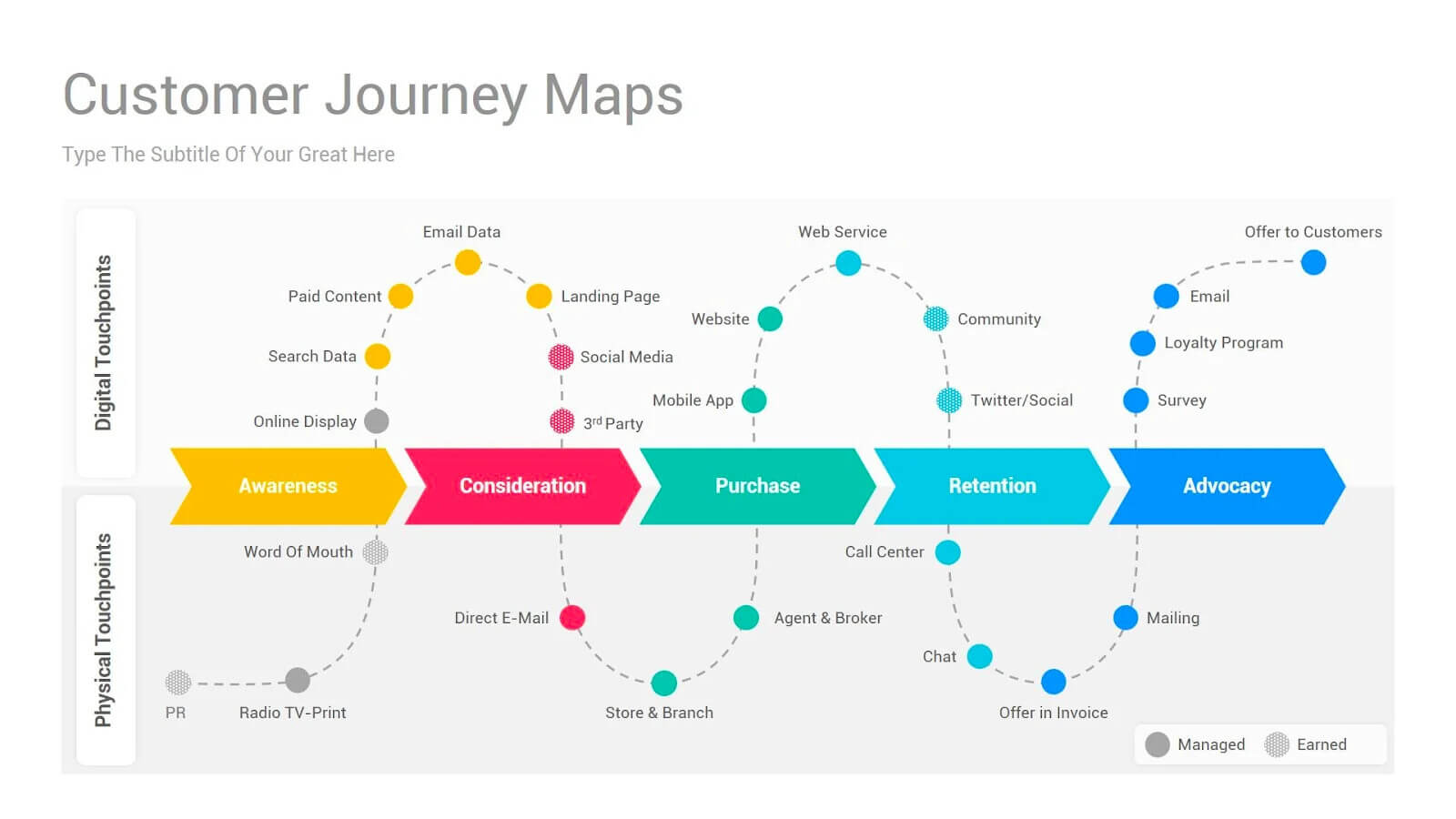
Source: woopra.com
How to map your clients’ journey
The process starts by clearly defining the journey map’s purpose, such as improving conversion rates, enhancing onboarding, reducing churn, or refining customer support. At the same time, it’s important to select a specific customer persona. Journey maps are most effective when they reflect the behaviours, motivations, and expectations of a clearly defined customer type rather than a broad audience.
Next, outline the journey’s scope and break it into logical stages that reflect how customers think and act, such as awareness, consideration, purchase, usage, and retention. For each stage, document what customers are actually doing and where interactions take place, including websites, emails, sales conversations, products, or support channels. Capturing customer thoughts and emotions at each step is critical, as frustration, uncertainty, and satisfaction often reveal the most meaningful insights.
Once the journey is mapped, analyze it to identify pain points, gaps, and opportunities for improvement. These insights should be validated with real customer data, such as feedback, analytics, or support interactions, rather than relying solely on internal assumptions.
Finally, as customer needs, products, and channels evolve, the journey map should be revisited and used as a shared reference to guide cross-functional decisions and improve the overall customer experience.
Understanding the customer journey in digital marketing
In digital marketing, the customer journey refers to the complete series of experiences a person has with your brand from the first moment of awareness to long after they’ve made a purchase.
Unlike traditional funnels that focus mainly on conversion, a modern customer journey spans multiple channels and touchpoints like search engines, social media, email, paid ads, websites, and customer support. Mapping this journey helps marketers understand not just what customers do, but why they take each step.
While models vary, most digital customer journeys include the following core stages:
- Awareness – Prospects recognize a need or problem and first encounter your brand through digital channels like search, social media, or content marketing.
- Consideration – Prospects actively evaluate solutions and compare competitors, often engaging with targeted content, reviews, or email nurturing.
- Conversion – The visitor takes a desired action, such as signing up, purchasing, or requesting a demo.
- Retention – After purchase, tailored communication, support, and value-driven content help keep customers engaged.
- Advocacy – Satisfied customers refer others, leave reviews, or become loyal repeat buyers, multiplying the impact of your digital marketing efforts.
Mapping these stages visually enables marketers to pinpoint friction points and optimize experiences so that prospects move smoothly from one stage to the next. It also reveals opportunities for personalization and automation, which are key to delivering consistent omnichannel experiences.
Example of a customer journey template
| Customer Journey Stage | Customer Goal | Key Touchpoints | Customer Actions | Emotions / Pain Points | Marketing Opportunities | Metrics to Track |
| Awareness | Understand a problem or need | Social ads, search, blog posts | Sees an ad, reads an article | Curious, unsure | Educational content, SEO, paid ads | Impressions, reach |
| Discovery | Learn about possible solutions | Website, videos, social media | Visits website, watches video | Interested but cautious | Explainer pages, videos | Page views, time on site |
| Consideration | Compare options | Reviews, comparison pages, email | Downloads guide, reads reviews | Evaluating value | Case studies, comparison content | Lead conversions |
| Intent | Decide whether to buy | Pricing page, demos, chat | Requests demo, visits pricing | Hesitant, needs reassurance | Demos, testimonials, FAQs | Demo requests |
| Purchase | Complete transaction | Checkout, sales call | Purchases or signs up | Confident or anxious | Smooth checkout, incentives | Conversion rate |
| Retention | Get ongoing value | Email, onboarding, support | Uses product, contacts support | Satisfied or frustrated | Onboarding, support content | Repeat usage, churn |
| Advocacy | Share experience | Reviews, referrals, social | Leaves review, refers others | Loyal, enthusiastic | Referral programs, reviews | NPS, referrals |
Lets’ talk client journey
Are you looking to better engage with your audience? Let us help you audit your touchpoints and build better engagement pieces.
FAQ
A customer journey map is primarily strategic and visual—it shows how customers move through stages. A customer journey planner is operational as it helps marketers design, automate, and manage those journeys across channels using data and triggers.
Personalization ensures customers receive content and offers that match their needs, preferences, and journey stage. Using data such as past behaviour or demographics, marketers can tailor experiences that feel more relevant and engaging.
Customer journeys should be reviewed regularly. Changes in customer behaviour, new digital channels, evolving expectations, or updated business goals all require journey optimization to remain effective.
Yes. Even simple customer journey mapping can help small businesses better understand their customers, identify communication gaps, and improve marketing efficiency without requiring complex tools.
Common mistakes include focusing solely on conversion, ignoring post-purchase experiences, relying on assumptions rather than data, and failing to align teams across marketing, sales, and support.
A customer journey framework is a structured model that outlines how customers interact with a brand across different stages and touchpoints. It helps businesses understand customer behaviour, identify opportunities for engagement, and design consistent experiences across digital channels. By using a customer journey framework, marketing teams can align content, messaging, and technology with customer needs at each stage of the journey.
A customer journey framework provides clarity and consistency across marketing, sales, and service teams. It helps organizations deliver relevant messaging, reduce friction in the buying process, and improve customer satisfaction by ensuring each interaction supports the overall customer experience.
The 7 stages of the customer journey expand on traditional models to reflect modern, digital-first customer behaviour. These stages typically include:
- Awareness – The customer becomes aware of a need or problem.
- Discovery – They begin exploring information and possible solutions.
- Consideration – They compare options, brands, or products.
- Intent – The customer shows clear buying signals, such as repeat visits or inquiries.
- Purchase – The customer completes a transaction or conversion.
- Retention – Ongoing engagement encourages repeat business.
- Advocacy – Satisfied customers recommend the brand to others.
No. While the 7-stage model is widely used, the exact stages and terminology may vary across industries, business models, and customer behaviour. B2B, e-commerce, and subscription-based businesses often adapt the framework to better reflect their unique buying processes.
Yes. Customer journey stages are not static. New technologies, platforms, and customer expectations can introduce new touchpoints or alter how customers move through stages. Regular review and optimization are essential to keep your journey framework effective.