
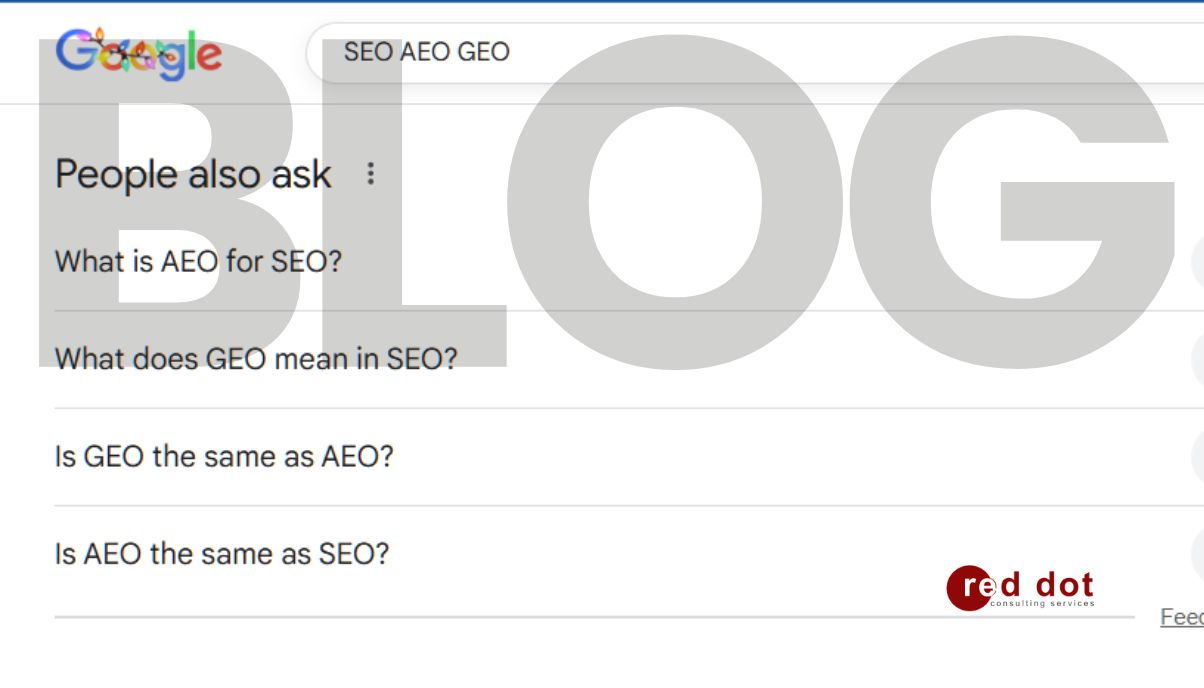
As users move from traditional search engines to voice assistants, AI chatbots, and generative search results, the rules of visibility are changing fast. That’s where SEO, AEO, and GEO come in.
While they’re often mentioned together (and sometimes used interchangeably), they each serve a distinct purpose in how content is discovered, interpreted, and delivered. Understanding the difference isn’t just a matter of terminology—it’s essential for building a future-proof content and search strategy.
In this blog, we’ll break down what SEO, AEO, and GEO actually mean, how they differ, where they overlap, and why modern brands can no longer afford to focus on just one.
What is SEO?
Search Engine Optimization (SEO) is the process of improving a website’s visibility on search engines like Google. When done well, SEO helps your site rank higher in search results, attract more organic (non-paid) traffic, and reach people who are actively searching for what you offer.
Rather than relying solely on ads, SEO focuses on long-term, sustainable growth by making your website easier to find, understand, and trust—both for search engines and for users.
In simple terms, SEO helps potential customers discover your business at the exact moment they need it.
How does SEO work?
SEO is made up of several interconnected strategies that work together to improve rankings and user experience:
- On-Page SEO: Optimizes individual web pages using relevant keywords, compelling titles, meta descriptions, headers, and internal links to improve relevance and readability.
- Off-Page SEO: Builds authority and credibility through external signals such as backlinks, brand mentions, and social sharing from trusted websites.
- Technical SEO: Ensures your website performs well behind the scenes by improving site speed, mobile responsiveness, indexing, security (HTTPS), and overall crawlability.
- Local SEO: Helps businesses appear in location-based searches by optimizing Google Business profiles, local listings, reviews, and geographic keywords.
- Content Optimization: Focuses on creating high-quality, valuable content that answers user questions, aligns with search intent, and keeps visitors engaged.
Together, these SEO components help search engines understand your website—and help your audience find you faster.
What is AEO?
Answer Engine Optimization (AEO) is the practice of optimizing content so AI-powered search engines—such as Google, Siri, and Alexa—can easily extract and display instant, direct answers to user questions.
As search behaviour shifts toward conversational queries and voice search, AEO helps brands stay visible when users are looking for quick, precise responses rather than scrolling through multiple links. Instead of focusing only on rankings, AEO focuses on being the answer.
Why AEO matters
AEO enhances your visibility in high-impact search placements, including:
- Featured snippets that appear at the top of search results
- Knowledge panels that provide authoritative information
- Voice search results delivered by smart assistants
By structuring content for quick retrieval, AEO ensures your expertise is surfaced at the moment users ask a question—often before they even click a website.
How to make AEO work for your content
To succeed with Answer Engine Optimization (AEO), your content must be designed for speed, clarity, and easy extraction by AI-powered search engines. The goal is simple: make it effortless for AI systems to find, understand, and present your answer. Best practices for AEO success include:
- Structure content for easy scanning: Use clear headings, short paragraphs, bullet points, and lists so answers stand out immediately.
- Use concise, direct answers: Get to the point quickly. AI prefers short, definitive responses over long explanations.
- Optimize for voice search: Write in natural, conversational language that mirrors how people speak and ask questions.
- Leverage FAQs and structured data: Question-and-answer formats, lists, and schema markup make it easier for AI to extract key information.
What is GEO?
Generative Engine Optimization (GEO) focuses on structuring content so AI-driven platforms like ChatGPT, Gemini, and Perplexity can analyze, synthesize, and surface it within AI-generated responses.
Unlike traditional search, generative engines don’t just rank pages—they combine insights from multiple sources to produce direct answers. GEO increases your chances of being referenced, summarized, or cited when AI tools generate responses for users.
How to make GEO work for your content
To perform well in generative search environments, your content must be easy for AI systems to interpret, trust, and reuse. Best Practices for GEO include:
- Use clear structure and organization: Well-defined headings, structured sections, and logically organized content help AI retrieve the right information quickly.
- Write in a natural, conversational style: Content should mirror how users phrase questions, making it easier for AI to match and reuse answers.
- Demonstrate E-E-A-T: Ensure your content reflects Experience, Expertise, Authority, and Trustworthiness by using accurate information, credible sources, and real-world insights.
Comparing SEO, AEO, GEO
Aspect | SEO | AEO | GEO |
Rank higher in search engine results | Be selected as the direct answer | Influence AI-generated responses | |
Optimized For | Google & traditional search engines | AI-powered answer engines & voice search | Generative AI platforms (LLMs) |
Search Experience | Users click links | Users get instant answers | Users receive synthesized AI responses |
Key Platforms | Google, Bing | Google Featured Snippets (AI overviews), Siri, Alexa | ChatGPT, Gemini, Perplexity |
Content Focus | Keywords, backlinks, site optimization | Clear, concise answers | Structured, authoritative insights |
Content Format | Long-form pages, blogs | FAQs, definitions, lists | Well-structured, expert-driven content |
Writing Style | Informational & keyword-driven | Simple, direct, conversational | Natural, contextual, authoritative |
Technical Elements | On-page, off-page, technical SEO | Schema, FAQs, structured data | Content clarity, E-E-A-T signals |
Success Metric | Rankings, organic traffic | Featured snippets, voice responses | AI citations, references, visibility |
User Action | Click and explore | Get an immediate answer | Trust and follow AI-generated guidance |
Get help SEO, AEO, GEO!
Would you like your content to do better with search engines, answer engine and generative AI tools? Let us review your website and suggest ways to make it work harder for you.
FAQ
SEO focuses on ranking web pages, while AEO focuses on being the answer. AEO prioritizes concise responses, structured formats, and conversational language over long-form keyword optimization.
AEO targets direct answers, while GEO targets AI-generated summaries and explanations. GEO emphasizes context, authority, and trust so AI systems can confidently reuse your content in synthesized responses.
Yes. SEO is still the foundation. AEO and GEO build on SEO by adapting content for how AI-powered search and generative tools deliver information.
FAQs, definitions, step-by-step lists, and short paragraphs with clear answers work best. Content should be easy to scan and written in natural language.
Well-structured, authoritative content that demonstrates expertise and real-world experience. Clear headings, logical flow, and trustworthy information are essential.
SEO helps users find your content.
AEO helps your content become the answer.
GEO helps your brand influence what AI generates.
No. Businesses of all sizes benefit from combining SEO, AEO, and GEO—especially those looking to stay visible as search behavior shifts toward AI-driven experiences
Focusing only on rankings. Today’s search landscape rewards clarity, structure, and authority—not just keywords.
AI Overviews are AI-generated summaries that appear directly on search results pages, answering a user’s query without requiring them to click through multiple links. Instead of showing only a list of blue links, the search engine synthesizes information from various sources and presents a concise, conversational response at the top of the page.
Answer questions quickly and holistically
Reduce the need for follow-up searches
Cite or reference multiple sources within a single generated response
AEO focuses on structuring content so it can be easily understood and extracted as a direct answer. AI Overviews rely heavily on AEO principles:
Clear, concise answers to specific questions
Well-structured content (headings, lists, FAQs)
Strong topical authority and factual clarity
If your content is optimized for AEO, it increases the likelihood that parts of it will be pulled into an AI Overview as a cited or summarized source.